When To Wear A Body Harness For Man Lifts

Mediapayperlead-com December 11, 2024

When To Wear A Body Harness For Man Lifts

Meta Description: Understand that wearing a full-body harness is necessary for occupational health and safety while operating man lifts. Key fall protection factors for these elevated work platforms are analyzed based on OSHA standards.

Working at heights comes with inherent risks that require proper safety measures. This article analyzes when a body harness is necessary for man lifts such as scissors and boom lifts.

A clear understanding of regulatory standards helps ensure the well-being of workers. Let’s examine these guidelines and how to comply with harness requirements for elevated work platforms.

Key Takeaways

  • OSHA requires fall protection when using aerial lifts like boom lifts. A harness and restraint lanyard must be worn.
  • Fall protection isn’t mandatory for scissor lifts as long as guardrails are intact, but it’s still recommended.
  • Proper planning is important when using lifts. Consider lift design, work environment, and fall clearance to ensure fall protection is implemented safely.

Understanding the Need for Body Harnesses in Man Lifts

Providing fall protection for workers operating elevated machinery is crucial. Falls from man lifts and aerial work platforms can cause serious injuries or even loss of life. Using proper personal protective equipment like body harnesses can help ensure the safety of those working at heights.

Different Types of Man Lift

A few common elevated work platforms are frequently used in construction and maintenance tasks.

  • Aerial lifts: Also called boom lifts or cherry pickers, aerial lifts have an extendable arm or boom that allows vertical and horizontal movement. This makes them suitable for tasks requiring an extended reach.
  • Scissor lifts: Scissor lifts provide a vertically elevated work platform with a scissor-like mechanism to raise and lower. They offer vertical movement and a large platform, ideal for tasks on flat surfaces.

OSHA Regulations for Fall Protection in Lifts

The Occupational Safety and Health Administration (OSHA) has established standards for fall protection depending on the type of lift used in general industry.

  • OSHA requires workers to wear a personal fall arrest system like a body harness for aerial lifts. This is because the risk of being ejected from the lift is significant during travel or on uneven surfaces.
  • In scissor lifts, standard guardrails typically satisfy protection needs. However, additional measures may be required if guardrails are compromised or during tasks that increase fall risks, like working near edges.
  • A personal fall arrest system or travel restraint system featuring a body harness prevents falls and limits forces on the body in the event of a fall from heights.

Using lifting equipment without fall protection puts workers at risk of severe injury or even death from a fall. Following regulations and proper equipment ensures a safe working environment when tasks require an elevated position.

When is a Harness Necessary?

A harness is necessary for fall protection whenever an individual is exposed to fall hazards at elevated heights. Personal fall arrest systems (PFAS) are designed to include harnesses and crucial safety equipment for preventing injuries from aerial lifts.

Requirements for Boom Lifts

For boom lifts, which provide both vertical and horizontal movement, OSHA requires the use of fall restraint or fall arrest systems at all times due to the significant risk of ejection from the boom lift. Workers must wear a harness connected to an anchor point or retractable lifeline to prevent being catapulted out of the basket. These personal fall arrest or restraint system systems ensure worker safety while operating boom lifts.

Requirements for Scissor Lifts

Scissor lifts typically have more prominent, enclosed work platforms with guardrails as passive fall protection. OSHA does not mandate harness usage for standard scissor lift operation. However, employers must carefully evaluate job tasks and conditions to determine if additional active fall protection is necessary.

Choosing the Right Harness

Selecting the appropriate harness is crucial for worker safety when working at heights. A harness is the most important personal protective equipment in fall protection systems. It must be chosen carefully based on the work environment and tasks.

Full Body Harness vs. Chest Harness

A full-body harness is always preferred over a chest one when wearing a body harness for man lifts and fall protection. It distributes fall arrest forces over thighs, pelvis, shoulders, and torso, which helps reduce injury potential to the user. A full-body harness offers full body coverage and freedom of movement compared to a chest harness, which only protects the upper body. It suits all activities, including climbing, overhead work, etc.

Other Harness Features to Consider

Along with choosing between a whole body or chest harness, there are other essential factors to evaluate. The harness material should be durable enough to withstand wear and tear and environmental conditions on the jobsite. Features like padding, adjustability, and attachment points are crucial. Padding provides comfort and impact absorption in case of a fall.

A harness must include attachments at the back (dorsal D-ring) and sides (side D-rings) for connecting fall arrest equipment, tools, and other gear. Adjustable and customizable straps allow a comfortable fit for different body types while wearing other protective equipment like hard hats. Appropriate harness anchorage and hardware compatible with the fall arrest, restraint, or rescue system are also essential. These factors ensure the safety, functionality, and performance of the harness.

Using the Harness Correctly

Proper harness fit and attachment are essential for fall protection. A harness that is not adjusted correctly or attached to unapproved anchor points puts the worker at risk of injury from a fall. Taking the time for a few simple checks can help ensure a safe work environment at heights.

Attaching to Designated Anchor Points

Attaching fall arrest lanyards and lifelines to anchor points rated for such use is critical. Guardrails are designed for a different purpose and should never be used as anchors. The lift manufacturer’s instructions or a qualified person can identify approved attachment locations designed with safety factors to withstand dynamic forces in case of an arresting fall. Using unrated points can jeopardize the system’s integrity and endanger workers.

Adjusting for Proper Fit

A full-body safety harness that is too loose or tight can create hazardous conditions. When open, the harness may not distribute fall forces properly to more vital parts of the body and could cause injury. If it is too tight, circulation may be reduced, affecting performance and safety.

Taking a few moments to adjust all straps, including leg loops and shoulder pads, ensures the harness fits snugly but not uncomfortably. This proper fit is necessary for fall protection harnesses with aerial lifts, scissor lifts, and other mobile elevating work platforms.
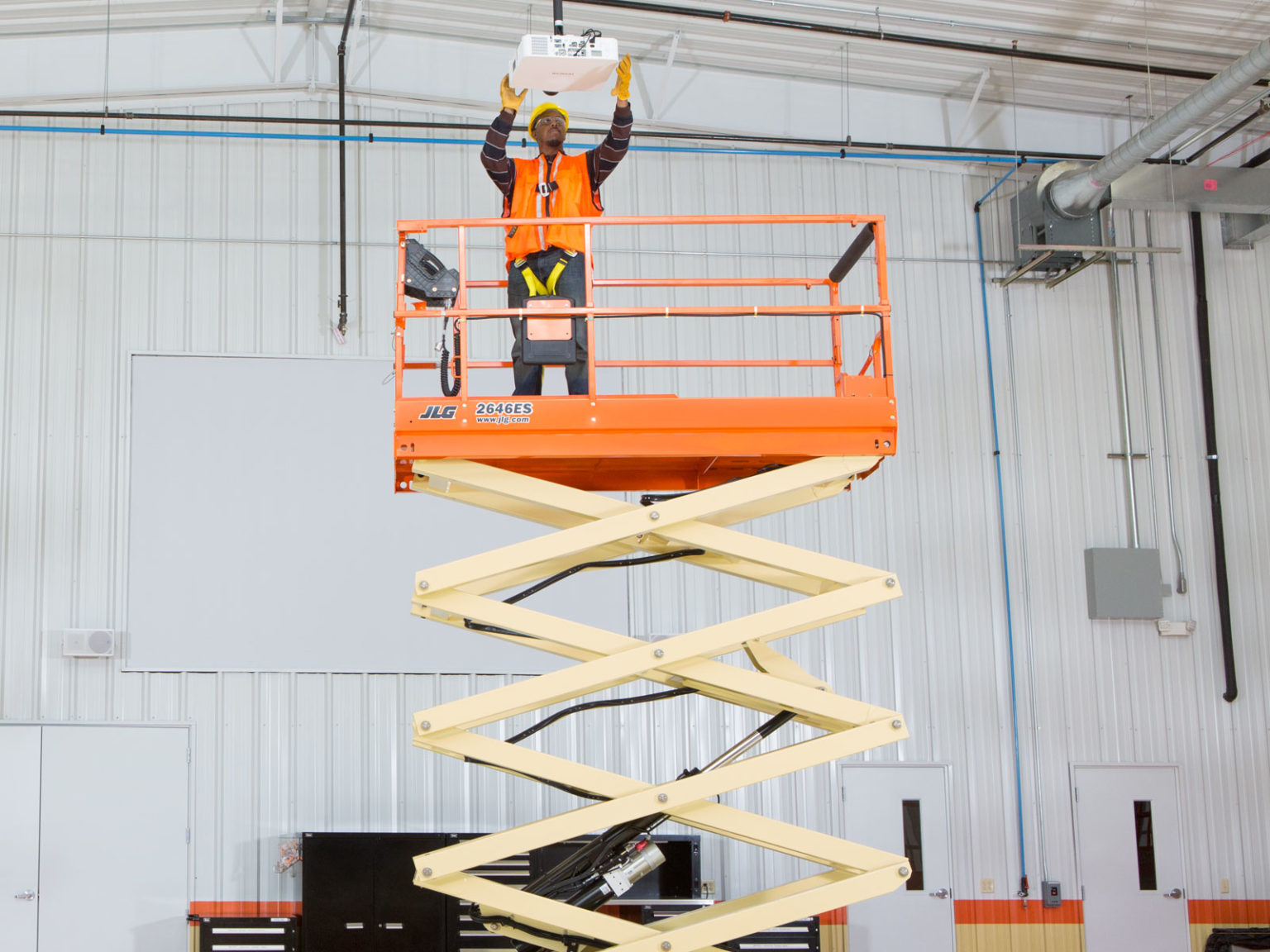
Worker in high visibility vest using a scissor lift for maintenance work inside an industrial building

Benefits of Using a Harness

Using the proper personal protective equipment is crucial for worker safety. Harnesses provide lower protection for employees performing tasks at height.

Increased Safety

A harness spreads the fall arrest forces across the body belt, thighs, pelvis, shoulders, and chest in the event of a fall. This significantly reduces the impact on the body compared to a fall protection system that only a body belt or uses a belt.

A harness also prevents injuries caused by hard falls, keeping the worker’s body securely upright. This is a significant safety benefit for tasks requiring an aerial lift where the risk of ejection from the basket is present.

Peace of Mind

Feeling secure while working at height is essential for mental well-being and focus on the job. Harnesses provide workers with confidence and peace of mind by ensuring complete body protection in case of an accident.

When wearing a harness fitted with a side lanyard attached or a retractable lifeline anchored above, employees are less stressed about fall hazards. This lets them concentrate fully on the task rather than worrying about falls, increasing productivity. Regular harness use as part of a fall arrest system can help reduce anxiety and improve morale for inspections or repairs of building facades, bridges, and other structures.

Proper harness selection and fitting are important to gain these safety and productivity benefits. Employers must provide harnesses approved by national standards and train workers on correct donning, sizing, inspection, and care.

Developing a Fall Protection Plan

Developing a comprehensive fall protection plan is crucial to ensure the safety and well-being of workers. A well-thought-out fall altogether plan helps establish clear guidelines, responsibilities, protection requirements, and protocols for fall arrest systems, fall restraint equipment, aerial lifts, and more.

Training Employees

Providing proper training to employees on fall protection equipment and safety practices is a key part of an effective plan. Training helps employees understand proper procedures for inspecting personal fall arrest systems, setting anchors, using fall restraint devices, and more. Regular refresher sessions keep fall hazards and protocols top of mind.

Conducting Inspections

Another important element is routine fall protection equipment inspections like full body harnesses, lanyards, lifelines, fall arrest systems, and anchorage connections. Inspections help determine if any fall hazard equipment shows signs of wear, corrosion, cuts, or tears that could compromise integrity.

Frequently Asked Questions (When To Wear A Body Harness For Man Lifts)

Scissor lifts typically require a fall restraint system rather than fall arrest since standard guardrails provide protection. However, additional restraint equipment may be needed if guardrails are compromised or when transitioning on and off the scissor lift. Employers must evaluate jobsite hazards and tasks to determine the appropriate fall protection measures.
Scissor lift guardrails alone do not meet the strength requirements for fall protection anchorages as they are not rated to withstand forces from a fall. Employers and lift operators should only connect workers to boom lifts at designated anchorage points that are part of the lift’s structure and order for fall arrest.
While OSHA does not require harnesses for indoor or operating scissor lifts or aerial lift operators’ use, employers must protect workers from fall hazards. Indoor work still poses risks like tripping hazards or accidental lift movement. As a precaution, employers may require harnesses tethered to the lift by restraint lanyards to prevent falls and ensure worker safety.
When transferring to an elevated work area from an aerial lift, workers must wear fall protection and arrest equipment like a twin-legged lanyard to connect sequentially to the aerial lift and off-board anchor point for 100% tie-off during the transition. This prevents exposure to fall hazards between disconnected anchor points.

What Are The OSHA Standards for Man Lift: A Guide to Safety Compliance

Mediapayperlead-com December 11, 2024

What Are The OSHA Standards for Man Lift: A Guide to Safety Compliance

Meta Description: Learn about OSHA’s mechanical inspection and operational requirements for man lifts to safely transport personnel between floors, inspection guidelines, manufacturer, and operating rules.

This article provides an overview of vital safety guidelines for operating man lifts or boom lifts. It analyzes OSHA regulations and requirements for running man lifts, lift inspections, training, personal protective pole structure or equipment, and operating procedures.

Properly implementing these safety protocols is vital for equipment manufacturer employees and rental businesses to safely carry out high-altitude tasks while protecting employees and complying with occupational safety tips, regulations, and standards.

Key Takeaways

  • Follow OSHA training requirements and always ensure operators are certified before using man-lifts
  • Inspect the equipment thoroughly, check for issues, and ensure the surroundings are safe before operating
  • Wear proper safety gear, do not exceed weight limits, and always be aware of potential hazards

What is a Man Lift?

A man lift, also known as a boom lift, an aerial lift device, or a boom lift, is a mechanical device that provides temporary access to elevated heights for workers for inspection, maintenance, and construction tasks. Man lifts help complete jobs more efficiently and safely than other means of ladders or scaffolding.

Types of Man Lifts

  • Scissor lifts have a work platform mounted on extending beams that fold like a scissor mechanism. They provide adjustable heights up to 28-30 feet.
  • Boom lifts have a work platform at the end of a hydraulically operated boom. Boom lifts can reach heights from 20 feet to 120 feet and beyond.
  • Spider lifts use a system of articulating arms rather than a single boom. They can access hard-to-reach areas, and their low transport height allows navigation under low ceilings and through narrow openings.

Parts of a Man Lift

The key components of a man lift include:

  • Platform: The work area where workers stand. It is equipped with railings and fall protection.
  • Controls: Buttons or levers to raise, lower, extend, or retract the lift. Controls are located on the platform or at ground level.
  • Power source: Usually electric but can also run on batteries or internal combustion engines.
  • Mast/boom: A vertical mast or horizontal boom is used to raise and position the platform and is made of steel or aluminum alloy for strength and durability.
  • Wheels/tracks: Allows moving the lift to job sites. Scissor lifts have wheels, while boom lifts may have wheels or tracks.
  • Safety devices: Includes alarms, lights, and limit switches to prevent tip-overs and ensure safe operation.

OSHA Regulations for Man Lifts

OSHA has established clear guidelines, practices, training, and standards to ensure the safety of workers using man lifts, also known as aerial lifts or boom lifts. Following these regulations is crucial to prevent any accidents at height.

Design and Construction Requirements

OSHA specifies requirements for the design and construction of man lifts. Floor openings must be an appropriate size for the belt width. Landings and emergency landings need to be included within the required travel distance. Guardrails and toeboards are mandatory at all floor openings and landings. Conical or floating guards below floor openings protect workers.

Man lifts must have front brakes, self-engaging brakes, emergency stop devices, and limit switches to stop the lift at the top automatically or if a step passes the landing. Instructions and warning signs informing users of common hazards and how to operate and exit the lift safely are essential.

Operating Procedures and Restrictions

OSHA stipulates operating rules like prohibiting the transport of materials or freight. Only trained, certified, and authorized personnel are permitted to manlift. They shall not be operated. Periodic inspections by competent individuals must occur at least every 30 days to ensure all safety components like steps, handholds, ladders, guardrails, and warning lights are fully functional.

Setting up a Man Lift Safely

Setting up a man lift safely is crucial to how employees avoid workplace accidents and hazards. Proper safety protocols must be followed diligently during the entire process.

Securing the Work Area

The first step of the shutdown procedure involves securing the entire work area where the man lift will be operated. The area underneath and all adjacent regions must be cordoned off to ensure no risk of unauthorized entry. Clear demarcations using safety cones, warning signs, or barrier tapes should be placed around the perimeter to warn others regarding the danger of an ongoing operation. Pedestrian or vehicle movement must be barred in that secured zone until operations are complete.

Setting Outriggers and Guardrails

Once the work area adjacent to the pole structure is secured, the man lift needs to be positioned carefully. Its outriggers must be extended fully on each lifting arm to provide the structure with a stable base before any work at height begins. The manlift outriggers should be set upon solid, level ground wherever possible to avoid tipping risks. Guardrails must be installed surrounding the work platform at the appropriate height as an additional safety measure before the platform is raised.

Several checks of the aerial lifts are essential before the commencement of work. This includes inspecting the belt tension to ensure the safe functioning of the boom lift. Electrical and hydraulic systems, emergency stops, and safety devices must be tested. Proper belt tension should be applied, and safety tips like using fall protection gear or a fall arrest system may need review.

Safely Operating a Man Lift

Safely operating a man lift requires proper operator training and understanding of pole structure, equipment control, hazards, and safety features. Following guidelines for controlling, loading, moving, and responding to emergencies helps the operator minimize risks.

Controls and Safety Features

Man lifts have various controls and safety features to allow for safe operation. Controls include buttons or levers to raise, lower, and drive the boom and basket. Emergency stop buttons immediately cut power if engaged. Safety railings surround the basket perimeter, and fall arrest harness attachments are provided. Limit switches prevent over-travel, and two braking systems stop all movement. Proper belt tension and adjacent pole safety are also necessary.

Proper Loading and Movement

Only trained and authorized personnel working properly should operate aerial lifts. Before use, inspect for defects according to the Osha requirements. Floor landings must be clear of obstacles and lighting adequate. Load the basket evenly and ensure the weight limit is not exceeded. Move smoothly and avoid sudden movements to keep the weight limit at the lift level. Maintain stable contact with the ground or surface at all times.

Responding to Emergencies

If issues arise, respond carefully following safety tips. Press the emergency stop button if the lift malfunctions or hazardous conditions appear. Do not attempt repairs without proper training. Do not operate the lift in high winds; lower the boom to the ground instead. If power fails, climb the ladder with a fall arrest harness. Otherwise, wait calmly in the basket for assistance. With awareness of common hazards, proper gear, and care, aerial lifts can be operated safely.

Common Hazards and Accident Prevention

Manlifts can be very useful for tasks that require working at heights, but they also present some inherent risks that operators must be aware of. Taking proper precautions is necessary to avoid accidents and injuries. Some of the main hazards include:

Tip-overs and Falls

Tip-overs and falls are serious risks associated with operating man and aerial lifts. They can be caused by over-reaching, overloading the equipment, using it on uneven or unstable ground, or encountering adjacent poles or overhead obstructions. Following the safety manual instructions regarding capacity, set-up, and guardrails is essential.

Struck-by Injuries

Being struck by falling objects is another potential hazard. When working in the lift, operators must be aware of the danger of their surroundings and watch out for any loose materials, tools, or other items that could fall from above.

Electrocution and Fire Hazards

Manlifts require electricity and pose electrocution risks if the machine or any part of the operator’s body comes into contact with power lines. It is essential to inspect for damaged wiring or loose connections, keep a safe distance from overhead lines, and avoid using lifts in stormy conditions. Fuel-powered lifts also carry a fire risk that can be mitigated through proper maintenance and refueling safety practices. Storing fuel appropriately away from heat sources and having an empty fire extinguisher somewhere nearby are sensible precautions.

Frequently Asked Questions (When To Wear A Body Harness For Man Lifts)

Scissor lifts typically require a fall restraint system rather than fall arrest since standard guardrails provide protection. However, additional restraint equipment may be needed if guardrails are compromised or when transitioning on and off the scissor lift. Employers must evaluate jobsite hazards and tasks to determine the appropriate fall protection measures.
Scissor lift guardrails alone do not meet the strength requirements for fall protection anchorages as they are not rated to withstand forces from a fall. Employers and lift operators should only connect workers to boom lifts at designated anchorage points that are part of the lift’s structure and order for fall arrest.
While OSHA does not require harnesses for indoor or operating scissor lifts or aerial lift operators’ use, employers must protect workers from fall hazards. Indoor work still poses risks like tripping hazards or accidental lift movement. As a precaution, employers may require harnesses tethered to the lift by restraint lanyards to prevent falls and ensure worker safety.
When transferring to an elevated work area from an aerial lift, workers must wear fall protection and arrest equipment like a twin-legged lanyard to connect sequentially to the aerial lift and off-board anchor point for 100% tie-off during the transition. This prevents exposure to fall hazards between disconnected anchor points.

Safety Guidelines For Man Lift Operation

Mediapayperlead-com December 11, 2024

Safety Guidelines For Man Lift Operation

Meta Description: Learn the top OSHA regulations and industry standards for operating man lifts safely, along with common hazards and precautions when using man lifts.

This article provides an overview of aerial lift safety for operators, supervisors, and pedestrians. It highlights essential considerations for safely operating aerial lifts, commonly known as boom or scissor lifts.

Topics covered include OSHA regulations, typical hazards, inspection procedures, fall protection, slope safety tips, weight limits, and more. The aim is to help rental companies and their customers safely and productively utilize aerial lifts in various applications.

Key Takeaways

  • Aerial lifts help people reach heights but can be dangerous if not used properly.
  • Always inspect lifts for safety, get trained, and follow rules to prevent falls, tip-overs, and other hazards.
  • Watch for power lines, slopes, wind, and weight limits. Make sure areas are clear before operating.
  • Wear fall protection and secure tools, and use traffic control to keep pedestrians safe near lifts.
  • Regular maintenance and inspections help equipment stay in good condition.

Understanding Aerial Work Platforms

Aerial work platforms, commonly known as aerial lifts or bucket trucks, are essential for safely accessing work at heights. When used correctly, they can help complete jobs more efficiently while protecting worker safety.

What Are Aerial Work Platforms?

Aerial work platforms are mechanical devices that position personnel and their necessary tools and equipment in elevated work areas.

Common types include boom lifts, scissor lifts, and aerial ladders, each designed to raise workers through various arrangements of extending booms, scissor-linked platforms, or articulating ladder sections.

Common Types of Aerial Work Platforms

One common type is the boom lift, where an extending hydraulic or mechanical boom raises a platform holding workers and cargo. Another frequent choice is the scissor lift, utilizing a platform lifted by scissor-linked arms that move vertically but not horizontally.

Aerial ladders fitted to truck beds also qualify as aerial work platforms, positioned and articulated through hydraulics to position bucket assemblies for elevated job sites.

When Are Aerial Work Platforms Used?

Aerial work platforms find applications in various industries whenever jobs require temporary access to elevated areas. Typical uses include construction for tasks like installing siding, electrical work involving overhead lines, and maintenance of buildings or infrastructure like bridges.

Utility line inspection, repair, and construction depend heavily on aerial lifts to position crews close to the work face. Their mobility allows rapid redeployment between projects, while built-in safety features help protect workers from falls and electrical hazards compared to ladders or scaffolding. Proper training ensures they live up to their potential for efficiently and safely accomplishing elevated tasks.

Potential Hazards of Operating Aerial Work Platforms

Aerial work platforms, also known as aerial lifts or boom lifts, provide an efficient means of accessing elevated workspaces. However, operating such equipment also carries certain inherent risks that operators must know.

1. Tip-Overs and Unstable Surfaces

One of the most severe hazards aerial lift operators may face is tip-overs, which can result from unstable ground conditions or excessive movement of the equipment. Boom lifts become less stable as their height increases.

Surfaces such as sloped terrain, bumpy pavement, debris, or uneven soil can shift the machine’s center of gravity and cause it to overturn.

Operators must inspect the work area thoroughly for unsafe surface conditions before operation and use outriggers or other stabilizing devices as the equipment manual recommends. They should also avoid rapid or erratic movements in an aerial work platform.

2. Falls

Falls from elevated heights are another critical risk for aerial lift users. Falls can occur if the operator is not anchored correctly inside the bucket or platform using a full-body harness. Harness attachments must be secured correctly to an anchor point supporting 5000 pounds per employee.

Operators must remain tied off at all times when the platform is raised. Railings, gates, and other protective equipment like fall protection devices must also be functional.

3. Struck by Objects

Operators and those below face hazards from falling objects when working at elevated levels. Tools, materials, or other items can accidentally slip from the work platform.

Proper handling and storage of equipment and the required use of hard hats below can help mitigate this risk. Operators must secure or contain all items in the bucket to prevent dropped objects.

4. Entanglements

Aerial lifts contain many moving parts that could cause entanglements. Examples are pulleys, ropes, chains, and outriggers. Pinch points exist where these components meet or articulate. Operators and service personnel must beware of loose clothing or personal items that could become caught. They should also keep hands and limbs clear while machinery is engaged.

5. Electrocution

Aerial work performed near power lines introduces an electrocution hazard. Boom sections or other parts of an insulated aerial device could lose insulation or develop leaks over time.

Operators must maintain safe clearance from electric power lines, and all energized electrical conductors as specified in the equipment manual. Only trained personnel who understand safety procedures should operate aerial lifts near power lines.

Training Requirements for Operators

Ensuring proper training of aerial lift operators is crucial for their safety and those of others around them. Regular and effective training helps operators understand all safe and proper aerial lift operation aspects.

OSHA Training Standards

As per OSHA regulations, only trained and authorized personnel are allowed to operate aerial lifts. All operators must undergo proper certification and training programs approved by OSHA before using aerial lifts.

The training must cover potential hazards associated with aerial lift safety tips on lifts, proper inspection procedures, safe operating practices, and emergency response procedures. Refresher training is required whenever operators are assigned to a different type of aerial lift or when new hazards are identified.

Contents of Effective Training Programs

Comprehensive training programs should address all potential hazards, including falls, electric shocks, tip-overs, and falling objects. Trainees must understand safety procedures, proper use of fall protection systems, safety inspection checks, maximum weight limits, safe working angles, and clearances as outlined in manuals.

Inspection and Maintenance

Regular inspection and maintenance of aerial lifts is crucial to ensuring safe working conditions for operators. A pre-use inspection identifies any issues before the operation, while consistent maintenance catches small problems before they become dangerous breakdowns. Performing regular checks is also required by safety regulations.

Pre-use Inspection Procedures

Before each work shift or use, the operator must inspect the aerial lift according to the manufacturer’s instructions. This includes checking fluid levels, wheels and tires, controls, safety features, and structural components for any defects, damage, or loose/missing parts.

The operator verifies that emergency controls, guardrails, and personal protective devices are present and functioning. Any issues identified during the inspection must be reported and repaired immediately per the proper procedures.

Regular Maintenance Best Practices

In addition to pre-use inspections, industry standards recommend scheduled maintenance every 150 hours of use or every three months, whichever comes first. An annual inspection by a certified technician within 13 months of the prior check is also necessary.

Regular maintenance allows minor problems to be addressed before becoming expensive repairs or safety hazards.

Safe Operating Practices

The safe operation of aerial lifts is of utmost importance. Following proper safety protocols and assessing potential hazards can help prevent injuries and ensure incidents are avoided. Adhering to all safety rules and guidelines, receiving proper training, regularly inspecting equipment, and limiting loads are key aspects of safe aerial lift operation.

Worksite Hazard Assessment

Before operating an aerial lift, the work area must be scrutinized for potential hazards. Some things to evaluate include slopes, holes, debris, overhead power lines, obstructions, uneven terrain, and weather conditions like high winds.

Inspection helps determine if the site is suitable for safe aerial lift operation or if hazards need addressing first. It is also vital to ensure that other equipment is kept sufficiently far away to avoid collisions or tip-overs.

Proper Use of Fall Protection

Using fall protection properly is crucial whenever working at elevated heights. Operators and other platform occupants must wear harnesses attached to designated tie-off points to prevent ejections and falls.

Load Capacity Limits

Aerial lifts have maximum weight limits to avoid overloading the equipment. These capacity limits factor in the weight of all occupants and any tools or materials on the platform. Operators should always check nameplates or manuals for load data to know their particular aerial lift’s rated workload.

Exceeding capacity can potentially lead to tip-overs or structural failures. It is essential to limit loads to rated specifications or below.

Proper safety protocols, including worksite hazard inspection records and assessments, correct fall protection usage, and staying within load capacity limits, are essential for safe aerial lift operation and for preventing potential incidents.

Following safety guidelines, receiving training, and carefully inspecting equipment also help ensure safe and compliant aerial lift usage. This protects both operators and others near aerial lift operations from harm.

Frequently Asked Questions (When To Wear A Body Harness For Man Lifts)

Scissor lifts typically require a fall restraint system rather than fall arrest since standard guardrails provide protection. However, additional restraint equipment may be needed if guardrails are compromised or when transitioning on and off the scissor lift. Employers must evaluate jobsite hazards and tasks to determine the appropriate fall protection measures.
Scissor lift guardrails alone do not meet the strength requirements for fall protection anchorages as they are not rated to withstand forces from a fall. Employers and lift operators should only connect workers to boom lifts at designated anchorage points that are part of the lift’s structure and order for fall arrest.
While OSHA does not require harnesses for indoor or operating scissor lifts or aerial lift operators’ use, employers must protect workers from fall hazards. Indoor work still poses risks like tripping hazards or accidental lift movement. As a precaution, employers may require harnesses tethered to the lift by restraint lanyards to prevent falls and ensure worker safety.
When transferring to an elevated work area from an aerial lift, workers must wear fall protection and arrest equipment like a twin-legged lanyard to connect sequentially to the aerial lift and off-board anchor point for 100% tie-off during the transition. This prevents exposure to fall hazards between disconnected anchor points.

Conducting Proper Risk Assessment and Mitigation for Man Lifts Usage

Mediapayperlead-com December 11, 2024

Conducting Proper Risk Assessment and Mitigation for Man Lifts Usage

Meta Description: Proper risk assessment and mitigation are crucial when using man lifts to work at heights. This guide outlines the steps to identify hazards and implement controls to use equipment and complete jobs safely.

Conducting thorough risk assessment and proper mitigation measures is crucial before operating man lifts. This helps create a safe working environment for lift operators and others on site. A risk assessment identifies potential hazards and corresponding controls to minimize dangers.

This article discusses the proper procedures involved in risk assessment for man-lift usage. Following these steps helps reduce risks and ensures compliance with safety standards.

Key Takeaways

  • Proper planning is essential before using equipment for working at heights. This includes assessing risks, selecting the right equipment, and inspecting the work area.
  • Potential hazards include tip-overs, falling objects, and electric shocks. These risks must be identified and addressed before starting any high-altitude tasks.
  • Safety protocols like wearing harnesses, barricading work areas, and training are vital to prevent accidents and ensure jobs are completed without issues.

Understanding the Importance of Risk Assessment

Risk assessment is a crucial process that helps identify potential hazards and mitigate risks before operating man lifts. A thorough risk assessment allows businesses to prepare a worker safety plan.

Why Risk Assessment Is Necessary Before Operating Man Lifts

Man lifts provide an efficient way to access high work areas, but operating them involves potential hazards and risks that require careful consideration. Risk assessment identifies safety issues associated with the work environment, equipment being used, and tasks involved.

This helps determine what controls need to be implemented. Assessing risks upfront helps minimize the chances of incidents occurring and prevents injuries. It also ensures compliance with relevant regulations.

Key Areas to Focus on During Risk Assessment

Some important aspects to evaluate are the work location, surface stability, overhead obstructions, weather conditions, and proximity to power lines. The intended tasks and duration of work must also be examined to select the right equipment type that can support the weight and has sufficient reach.

One can understand boom lift hazards like tip-overs or electrocutions through risk assessment and develop a plan accordingly. Inspecting the machinery, evaluating operator training needs, and devising emergency plans before commencing operations are equally crucial. Proper planning after a detailed risk assessment helps improve worker safety and reduces the potential hazards of boom lifts.

Performing a Thorough Site Survey

Before starting construction on any elevated work, a thorough site survey is crucial to identify potential risks and hazards. A diligent site survey allows workers to stay safe and complete the job efficiently.

Inspecting the Work Area and Surroundings

Inspecting the work area and its surroundings is integral to the site survey. The operator must examine the ground conditions around the work area. This includes checking for uneven surfaces like slopes, pits, or loose soil that could affect the stability of the aerial lift.

The operator must also look for overhead obstructions like power lines, branches, and other structures that may pose risks of collision or entrapments. Understanding the space around the work area is key to determining a safe set-up for the aerial lift and preventing any potential hazards.

Identifying Potential Hazards

Identifying possible hazards is essential to conducting a thorough site survey. The operator must look for hazards like shallow pits, bumpy pavement, or excavations that could lead to tip-overs. Additionally, inspecting for ground-level obstacles and checking the load-bearing capabilities of the ground is necessary.

Evaluating weather conditions like high winds is essential as it may impact the safe use of aerial lifts. The operator must remain aware of electrical conductors and other nearby energized equipment to avoid risks like electrocution. Completing a diligent site survey helps recognize potential hazards and take appropriate precautions before starting elevated work.

Choosing the Right Equipment

Choosing the right equipment for working at height is crucial to complete any job safely and efficiently. One must carefully consider the task and the environmental conditions to select a man lift that fulfills all requirements.

Considering the Task and Environmental Conditions

When assessing risk and determining equipment needs, it is essential to delve into the specifics of the task that needs to be completed. What exactly will workers or teams need to do while elevating, ted and what tools or materials will they require? Will the lift need to be moved periodically or remain stationary? Understanding task details helps ensure the right equipment capabilities are in place.

Environmental conditions must also be considered carefully. Will the lift be used indoors or outdoors? What is the nature of the ground surface – stable or uneven? Are there any overhead obstructions or power lines that could pose potential hazards? Close attention to the job location and preparation can help prevent safety issues before they occur.

Selecting a Man Lift Based on Requirements

With task and site specifics in mind, a suitable man-lift model can be selected to suit all application needs. Will a boom lift provide sufficient re each, or would a vertical lift’s compact design be better? Does the work demand a large-capacity scissor lift? Understanding attachment requirements, ground conditions, and other particulars will guide the choice of lift best able to perform and improve worker safety.

Key factors include working height, platform size, ground clearance, turning radius, drive functions, and load capacity. Choosing a lift with ratings exceeding anticipated job demands helps the team adequately address all potential risks. Referring to operator manuals confirms that specified equipment can be safely utilized for the intended purpose in any potential environmental hazards. Tproperght selection supports efficient and incident-free completion of work at elevation.

New JLG compact crawler boom lift isolated on white background, showcasing advanced mobility and safety features for elevated work sites

Evaluating Potential Risks

Evaluating potential risks is crucial to the planning process when working with aerial lifts. A thorough risk assessment helps identify hazards so appropriate control measures can be implemented. This helps ensure the safety of operators and those working around the equipment.

Machine-related Risks

Some common machine-related risks that must be considered include the working height and outreach of the aerial lift vehicle. Using an appropriately sized machine is essential as it prevents any over-extension of the equipment.

The rated capacity of the platform also needs attention to avoid overloading. Regular pre-use inspections can help detect issues such as faulty pneumatics or frayed wires so they can be addressed before use.

Job-specific Risks

The jobsite environment and intended tasks introduce certain risks as well. For example, any overhead power lines or other obstacles are critical to evaluate. Proper planning helps employees complete work in hard-to-reach areas safely. The potential for falling objects also warrants attention, especially during maintenance tasks. They understand that specific workplace hazards are critical to selecting proper control measures.

Other Risks

Other potential risks include uneven or unstable terrain as you climb and hazardous weather conditions like high winds. Work area inspection ensures the aerial lift can be safely set up and operated.

Following manufacturer instructions and guidelines for inclines and wind speeds prevents tip-over incidents. The safety of those on the ground must also be considered through exclusion zones and fall protection where needed. Close supervision is important to monitor proper lift use and help prevent unauthorized access or misuse of the equipment.

Implementing Control Measures

Implementing control measures is crucial to ensure safety while working with aerial lifts. Control measures aim to minimize risks and prevent accidents. Some important control measures include establishing safe work procedures, providing proper training, and developing a rescue plan.

Establishing Safe Work Procedures

Establishing standard, zed-safe work procedures is essential as it provides step-by-step guidance to workers. Procedures must address potential hazards identified during the risk assessment. For example, lift safety procedures should specify fall protection equipment like harnesses and lanyards for boom and scissor lifts to prevent potential falls from power lines or other overhead hazards.

Procedures should also list guidelines for inspecting lifts to check for potential hazards like hydraulic leaks, damaged rails, or controls. Following standardized procedures ensures consistency in safe operating practices.

Providing Proper Training

Proper training helps workers understand hazards and implement control measures effectively. Training covers the correct operation of lifts, emergency controls like emergency stop and lowering systems, and safety features like anti-two block devices.

Training is essential for high-risk tasks like working near power lines. It must include hands-on practice under expert guidance. Training should be provided to operators, supervisors, and maintenance staff. Refresher training ensures skills are up-to-date, particularly when new equipment or safe work practices are introduced.

Developing a Rescue Plan

A rescue plan is necessary to rescue anyone trapped safely or after an accident. The plan should consider potential incidents identified during the risk assessment. It must specify who is responsible for performing different rescue tasks.

The plan should also include training staff to use ground and platform controls of lifts to rescue occupants if needed. Emergency contact details of local rescue agencies should be available in case their expertise is required. The plan should be tested periodically to identify gaps and ensure it is effective when required.

Frequently Asked Questions (When To Wear A Body Harness For Man Lifts)

Scissor lifts typically require a fall restraint system rather than fall arrest since standard guardrails provide protection. However, additional restraint equipment may be needed if guardrails are compromised or when transitioning on and off the scissor lift. Employers must evaluate jobsite hazards and tasks to determine the appropriate fall protection measures.
Scissor lift guardrails alone do not meet the strength requirements for fall protection anchorages as they are not rated to withstand forces from a fall. Employers and lift operators should only connect workers to boom lifts at designated anchorage points that are part of the lift’s structure and order for fall arrest.
While OSHA does not require harnesses for indoor or operating scissor lifts or aerial lift operators’ use, employers must protect workers from fall hazards. Indoor work still poses risks like tripping hazards or accidental lift movement. As a precaution, employers may require harnesses tethered to the lift by restraint lanyards to prevent falls and ensure worker safety.
When transferring to an elevated work area from an aerial lift, workers must wear fall protection and arrest equipment like a twin-legged lanyard to connect sequentially to the aerial lift and off-board anchor point for 100% tie-off during the transition. This prevents exposure to fall hazards between disconnected anchor points.

The Essential Guide to Personal Protective Equipment for Man Lift Operation

Mediapayperlead-com December 11, 2024

The Essential Guide to Personal Protective Equipment for Man Lift Operation

Meta Description: Learn the essential safety tips any aerial lift operator should know before ever operating an aerial and equipment, including being certified, inspecting the lift and work area, following weight limits, wearing fall protection, and avoiding hazards like power lines.

Aerial lifts are commonly used in construction and maintenance work. This article analyzes important aerial lift safety topics like training requirements, personal protective equipment, and operating procedures.

The goal is to give readers an overview of best practices while operating aerial lifts. Safety guidelines are essential to avoid serious injury or accidents on the jobsite.

Key Takeaways

  • Operators must wear proper personal protective equipment like safety harnesses, protective footwear, and eye protection when using man lifts.
  • Inspect the lift and work area for hazards before use. Only certified operators should use lifts.
  • Follow manufacturer guidelines and do not exceed weight/reach limits. Remain stable and avoid overhead hazards.
  • Use fall protection, keep enclosed in scissor lifts, and lower before moving. Secure properly in boom lifts.
  • Receive adequate training for lifts and safety compliance to prevent accidents.

Importance of Personal Protective Equipment (PPE) for Man Lift Operators

Operating man lifts such as aerial, scissor, and boom lifts is risky due to working at heights. Personal protective equipment plays a vital role in mitigating these risks and ensuring the safety of lift operators.

Risks involved in a man lift operation

Some common risks involved in a man lift operation include falls from elevated platforms, falling objects, electrical hazards from nearby power lines, tip-overs due to unstable ground conditions, or exceeding weight/reach limits.

Adverse weather conditions like high winds can also endanger boom lift operators. Injuries ranging from minor cuts and bruises to severe fractures and even fatalities may result from such accidents.

Role of PPE in risk mitigation

  • Fall protection equipment like harnesses, lanyards, and retractable lifelines are essential to prevent injuries from falls. Proper anchoring points on lifts approved by manufacturers must be used.
  • Head protection using helmets protects operators from impact injuries due to falling objects.
  • Eye and face protection gear, including goggles and face shields, shield operators from flying debris and dust.
  • Foot protection using steel-toe boots prevents injuries to feet from heavy objects and sharp surfaces.
  • High-visibility vests and clothing ensure operators are visible to equipment operators below, reducing the risk of collisions.
  • Gloves protect hands from abrasions, cuts, and harmful chemicals.

By diligently following PPE requirements, operators can focus on their work safely without worrying about injuries. This also ensures compliance with OSHA regulations and prevents hefty penalties for non-compliance. PPE thus plays a pivotal role in employee personal safety and business continuity for lift rental organizations.

Key PPE Categories for Man Lift Operators

When working at heights, it is crucial for man lift operators to use the appropriate personal protective equipment or PPE based on their tasks and working conditions. Some key PPE categories that lift operators must be aware of include:

1. Fall Protection Equipment

Fall protection equipment such as full body harnesses, body belts, lanyards, retractable lifelines, self-retracting lanyards (SRLs), and horizontal lifelines help protect workers from fall hazards. As man lifts can be operated at significant heights, fall protection equipment is an essential part of the PPE ensemble for lift operators. Using fall arrest systems that dynamically arrest falls within acceptable deceleration distances can prevent serious injuries for workers who experience falls from lifts.

2. Eye and Face Protection

Working at heights increases the risk of eye and face injuries from falling or airborne debris and particles. Goggles, safety glasses, and face shields form an essential layer of protection for lift operators. Eyewear made of impact-resistant materials that comply with ANSI standards helps shield operators’ eyes from particles and flying objects. Tinted lenses also offer protection from UV radiation.

3. Hazardous Conditions Protective Equipment

Lift operators must use specialized protective equipment when working in hazardous locations involving chemicals, gases, or confined spaces. For example, chemical-resistant suits, gloves, boots, and respirators protect workers who handle toxic substances.

Flame-resistant clothing shields individuals from flash fire and electric arc hazards. Operators working with asbestos or lead require high-filtration respiratory protection. Lift operators need to understand workplace hazards and select PPE accordingly.

4. Ventilation Safety Equipment

Lift operators need ventilation equipment in poorly ventilated or enclosed areas to breathe clean air—powered air-purifying respirators supply filtered air when oxygen levels are low.

Supplied air systems provide breathing gases from external air sources in hazardous atmospheres. Ventilation attachments on lifts help dilute and remove contaminants from operator breathing zones.

Choosing the Right PPE

Choosing the proper personal protective equipment is essential for safety when operating different types of lifts. Appropriate PPE can help prevent injuries and protect operators from hazards on aerial lifts, scissor lifts, and other elevated work platforms. Some key factors must be considered to ensure the appropriate PPE is selected.

Factors to Consider for Different Types of Lifts

  • Type of lift being used: Aerial lifts, scissor lifts, and boom lifts have their potential hazards. The specific PPE required may vary depending on whether an operator uses an aerial lift, scissor lift, or other equipment.
  • Nature of work: The tasks performed and the hazards of the work environment dictate the necessary PPE. For example, jobs that require cutting or welding may need additional eye and face protection.
  • Height of work: As lifts can raise workers higher, fall protection becomes increasingly important. Harness requirements may change depending on how high the lift can elevate personnel.

Manufacturer Recommendations

Equipment manual guidelines – Manufacturers design lifts with specific safety standards in mind and recommend appropriate PPE. Operators should always check and follow the PPE requirements outlined in their lift’s manual.

Work Environment Hazards

  • Overhead obstructions: PPE selection considers risks from falling objects, power lines, or other overhead hazards that may be present above the work area.
  • Uneven or slippery surfaces: Foot protection becomes a priority if lifts are used on rough or slippery surfaces like wet grass, gravel, or unfinished floors.
  • Outdoor conditions: Working in extreme weather necessitates PPE for protection from elements like rain, snow, wind, or sun exposure. Appropriate head, eye, and skin protection is advised.

Common Safety Standards

By considering factors like lift type, work tasks, worksite hazards, and manufacturer guidelines, operators can select PPE that meets common safety standards like those set by OSHA.

This includes protective equipment for the head, eyes, face, hands, feet, body, and hearing; following safety standards helps prevent injuries and protects operators while working on aerial lifts, scissor lift operators, lifts, and other elevated work platforms.

Frequently Asked Questions (When To Wear A Body Harness For Man Lifts)

Scissor lifts typically require a fall restraint system rather than fall arrest since standard guardrails provide protection. However, additional restraint equipment may be needed if guardrails are compromised or when transitioning on and off the scissor lift. Employers must evaluate jobsite hazards and tasks to determine the appropriate fall protection measures.
Scissor lift guardrails alone do not meet the strength requirements for fall protection anchorages as they are not rated to withstand forces from a fall. Employers and lift operators should only connect workers to boom lifts at designated anchorage points that are part of the lift’s structure and order for fall arrest.
While OSHA does not require harnesses for indoor or operating scissor lifts or aerial lift operators’ use, employers must protect workers from fall hazards. Indoor work still poses risks like tripping hazards or accidental lift movement. As a precaution, employers may require harnesses tethered to the lift by restraint lanyards to prevent falls and ensure worker safety.
When transferring to an elevated work area from an aerial lift, workers must wear fall protection and arrest equipment like a twin-legged lanyard to connect sequentially to the aerial lift and off-board anchor point for 100% tie-off during the transition. This prevents exposure to fall hazards between disconnected anchor points.

A Comprehensive Man Lift Inspection Guide

Mediapayperlead-com December 11, 2024

A Comprehensive Man Lift Inspection Guide

Meta Description: Learn how to properly inspect aerial, scissor, and boom lifts to ensure safety and compliance with OSHA and ANSI regulations for aerial and boom lift part inspections.

Regular inspection of man lifts is essential to ensure the safety of operators and compliance with federal law and regulations. This guide provides a comprehensive overview of inspection requirements for aerial lifts as outlined by OSHA and ANSI.

It explains the types of inspections required, including pre-start, frequent, and annual inspections. Details on what aspects to check during inspections and how to conduct them properly are provided. The guide aims to help owners and operators of man lifts understand inspection requirements and best practices.

Key Takeaways

  • OSHA and ANSI require regular inspections of aerial lifts to ensure safety.
  • Inspections include pre-use, frequent checks, and annual assessments by a qualified mechanic.
  • Pre-use inspections involve visual checks, function tests, and work area inspections.
  • Annual inspections must occur every 13 months and address manufacturer guidelines.
  • Proper inspections can find issues early to prevent accidents and unplanned downtime.

Importance of Man Lift Inspections

Regular inspections of the aerial platform and lifts are crucial to ensure the safety of operators and bystanders, prolong the equipment’s lifespan, and remain compliant with regulations. When performed properly, inspections of aerial platforms can help identify potential issues before they lead to accidents or costly repairs.

Ensuring Safety

Safety is the top priority when working with aerial lifts. Frequent and annual inspections help detect cracks, leaks, loose mechanical fasteners, or other defects in components like booms, baskets hyd, hydraulic systems, and lift controls.

This reduces the risk of structural failures or loss of control that could harm the operator or the people below. Inspecting for proper function of safety devices, alarms, air systems, and controls also helps prevent accidents.

Prolonging Equipment Lifespan

Catching minor issues during inspections can prevent major repairs down the road. For example, a leak in the hydraulic system may cause fluid loss over time, but getting it addressed promptly through inspection avoids accelerated wear of components.

Similarly, loose bolts can be tightened before they cause other damage. Regular maintenance as per the inspection planned maintenance schedule helps equipment last longer with fewer breakdowns over its lifetime.

Compliance with Regulations

Both OSHA and ANSI have established guidelines for aerial lift inspections. Conducting pre-start checks, inspections, frequent verifications, and annual assessments by an aerial lift manufacturer according to these standards satisfies compulsory rules.

It also ensures lifts meet manufacturer specifications. Following inspection, protocols are important to avoid noncompliance penalties and keep certifications and warranties valid. Proper documentation of inspection results provides a record of due diligence if needed.

Applicable Regulations and Standards

Ensuring the safety of aerial lift equipment and operators is of utmost importance. Various regulations and standards have been established by governing bodies and manufacturers to mandate inspection protocols for aerial lifts. Adhering to these protocols helps identify potential issues and maintain compliance.

OSHA Regulations

The Occupational Safety and Health Administration outlines regulations for aerial lifts to promote workplace safety. OSHA requires pre-use inspections and checks for the proper functioning of controls, safety devices, fluid levels, and structural integrity.

Inspectors must look for fluid leaks, damage to wheels or other parts, aerial lift problems, and any loose or missing components that could hamper safe operation.

ANSI Standards

Developed by the American National Standards Institute, ANSI standards provide industry guidelines for aerial lift design, usage, and inspections.

ANSI mandates frequent inspections at defined intervals, such as every 150 hours of operation or every three months, whichever comes first.

Additionally, annual inspections must be completed by a qualified technician within 13 months of the prior inspection. Any issues identified during inspections require the aerial lift equipment mechanic to be removed from service until repairs are made.

Manufacturer Guidelines

Aerial lift manufacturers specify inspection procedures and items in equipment manuals based on lift type and design—operator manuals detail inspection criteria for booms, scissor lifts, and their components.

This includes wear pads, wheels and tires, hydraulic and electrical systems, and safety devices. Following manufacturer guidelines helps ensure lifts are regularly examined for defects as intended by the OEM and helps maintain compliance with applicable regulations.

Types of Aerial Lift Inspections

Aerial lifts play a vital role in many industries by allowing workers to access work areas at heights. However, to ensure safety while operating these machines, regulatory bodies like OSHA require different types of inspections at regular intervals. Let’s take a look at the various inspections involved.

Pre-Use Inspections

Before using an aerial lift, operators must conduct a visual and functional inspection to verify all components are in good working order.

This involves checking for fluid leaks, parts’ wear and tear, controls’ proper functioning, and safety devices. Any issues identified must be addressed right away. Conducting brief yet thorough pre-use inspections can help catch small problems before they worsen.

Frequent Inspections

Regulations require inspecting aerial lifts more comprehensively frequently, within three months or 150 hours of use – whichever comes first. A qualified technician examines components in greater detail for signs of damage, wear, or other safety concerns.

These inspections help identify issues that may not be noticed during pre-use checks. Taking lifts out of service for repairs allows continued safe operation.

Annual Inspections

A certified mechanic must inspect All aerial lifts yearly within 13 months of the prior check. Annual inspections involve thorough functions and structural integrity testing as outlined in industry standards. This allows the detection of any changes since the last inspections. Repairs are made to repairs are made to ensure safety compliance and performance over time.

Additional Inspections (if required)

Some boom lifts with chain/wire rope mechanisms demand extra inspections beyond regular schedules. Chains require biannual checks, while wire ropes must be replaced every 7,000 hours or 12 years. This assures such critical structural components will perform as intended, reducing risks from overuse. Additional oversight maintains critical systems’ dependability for safe work at heights all year.

Who Can Perform Inspections

When ensuring aerial lifts are safe, qualified individuals must conduct inspections. Regular inspections help identify any issues early on, reducing risks for operators. While operators can perform pre-start checks, other inspection types require specialized training.

Operator Pre-Use Inspections

Operators are well-suited to conduct critical pre-use inspections as they frequently operate the equipment. This allows them to check key lift components, like controls, safety mechanisms, and the work area.

As competent users, operators can efficiently perform pre-start checks before each use to catch minor issues and properly ensure the lift functions. Their frequent inspections involve visual and operational checks per the manufacturer’s guidelines.

Qualified Technician Inspections

More comprehensive inspection types, such as frequent, annual, and two-year inspections, must only be performed by suitably qualified technicians. Per industry standards, technicians conducting these checks must have expertise through training, knowledge, and experience working with the specific models.

They can conduct thorough mechanical, hydraulic oil, electrical, and structural equipment evaluations. Technicians perform inspections per the standards established by organizations like ANSI and OSHA.

Their qualified inspections after periods of use or storage help verify the lift is still safe for continued operation. Defects identified are then addressed before the equipment is put back into service.

Frequently Asked Questions (When To Wear A Body Harness For Man Lifts)

Scissor lifts typically require a fall restraint system rather than fall arrest since standard guardrails provide protection. However, additional restraint equipment may be needed if guardrails are compromised or when transitioning on and off the scissor lift. Employers must evaluate jobsite hazards and tasks to determine the appropriate fall protection measures.
Scissor lift guardrails alone do not meet the strength requirements for fall protection anchorages as they are not rated to withstand forces from a fall. Employers and lift operators should only connect workers to boom lifts at designated anchorage points that are part of the lift’s structure and order for fall arrest.
While OSHA does not require harnesses for indoor or operating scissor lifts or aerial lift operators’ use, employers must protect workers from fall hazards. Indoor work still poses risks like tripping hazards or accidental lift movement. As a precaution, employers may require harnesses tethered to the lift by restraint lanyards to prevent falls and ensure worker safety.
When transferring to an elevated work area from an aerial lift, workers must wear fall protection and arrest equipment like a twin-legged lanyard to connect sequentially to the aerial lift and off-board anchor point for 100% tie-off during the transition. This prevents exposure to fall hazards between disconnected anchor points.

Essential Guidelines for Fall Protection in Man Lifts

Mediapayperlead-com December 11, 2024

Essential Guidelines for Fall Protection in Man Lifts

Meta Description: Learn the OSHA regulations and essential safety guidelines for using fall protection equipment in man lifts or aerial work platforms to help protect workers against falls and keep them covered at heights.

Working at heights has inherent risks that can be mitigated through proper safety measures. As an expert in equipment rentals and fall protection guidelines, this article provides a comprehensive overview of the essential considerations for ensuring worker safety when operating man lifts.

We will examine the critical regulations for aerial work platforms and vertical mast lifts, highlight the differences in fall protection requirements, and explore best practices for compliance.

Key Takeaways

  • Understand OSHA requirements for fall protection in aerial lifts and scissor lifts. Wear a harness tethered to the lift when using boom lifts.
  • Know the differences between lifts – boom lifts require harnesses due to the risk of ejection, and scissor lifts rely on guardrails but use a harness if guardrails are insufficient.
  • Calculate fall clearance distances carefully. Use self-retracting lifelines for lower heights to minimize fall distance in case of a fall.

Understanding the Importance of Fall Protection

Working at heights has inherent risks that can be mitigated through proper safety measures. As an equipment rental expert focused on worker safety, I aim to educate clients on safety professionals and the necessary precautions for reducing hazards associated with elevated job sites.

Risks of Working at Heights

  • Falls from elevated surfaces are one of the leading causes of injuries in the construction and general industry. Working above 6 feet brings the risk of severe bodily harm or even death from a fall.
  • Unprotected falls can result in fractures, head injuries, spinal injuries, or other trauma. Without the necessary fall arrest systems, workers are exposed to grave dangers.
  • Inclement weather conditions like high winds, rain, or ice further exacerbate the risks by reducing stability and visibility at heights. Slips or loss of balance can quickly turn fatal without adequate fall protection.

OSHA Regulations on Fall Protection

  • OSHA mandates fall protection for any job requiring work at elevations of 6 feet or more. This includes tasks performed from aerial lifts, scaffolds, or rooftops.
  • Employers are responsible for providing personal fall arrest systems like full body harnesses, lanyards, lifelines, and anchorage connectors for workers exposed to fall hazards.
  • Fall restraint systems may be used as an alternative to fall arrest if the design prevents workers from reaching the edge from where a fall could occur.
  • Rescue plans must also be in place for any job utilizing fall protection to retrieve employees rapidly in the event of an arrest fall.

Through the implementation of fall protection measures like personal fall arrest systems, fall restraint systems, safety nets, or guardrail systems, risks from working at heights can be effectively reduced. According to regulatory guidelines, proper training and equipment selection are crucial to protect workers and ensure maximum safety compliance and incident prevention.

Types of Man Lifts

Different types of equipment are used for elevating personnel to height for various jobsite tasks. Understanding the key differences between them is important from the perspective of choosing the right tool for different applications and understanding fall protection requirements such as maintaining safety compliance.

Aerial Lifts

Aerial lifts, called boom or cherry pickers, are mobile elevating work platforms providing vertical and horizontal movement capabilities. They consist of an articulating arm or boom and an enclosed platform or basket at the end.

This unique configuration allows workers to perform tasks requiring extended reach, such as building exteriors or structure maintenance. The platform can be maneuvered across multiple planes, enabling access to tight and hard-to-reach areas.

However, the movement capabilities also necessitate stringent fall protection measures by regulatory standards to prevent the ejection of personnel from the basket.

Scissor Lifts

Scissor lifts, in contrast, offer vertical movement only through a scissor-like mechanism that raises and lowers the platform in a straight line. They provide access to moderate heights within limited horizontal space and are ideal for indoor applications involving flat surfaces.

An advantage is that they accommodate larger work platforms compared to aerial lifts. As scissor lifts do not articulate like boom lifts, the risk of accidental ejection is minimal. Therefore, fall protection requirements differ as guardrails alone may suffice in most cases per guidelines.

Fall Protection Requirements for Aerial Lifts

Ensuring the safety of workers operating aerial lifts is paramount. Proper personal fall protection equipment goes a long way in preventing injuries from falling from heights. Personal fall arrest systems are a crucial part of fall protection requirements for aerial lifts set by regulatory bodies.

Personal Fall Arrest Systems

Per occupational safety guidelines, workers must wear personal fall arrest systems such as full body harnesses when working from aerial lifts like boom lifts. The mobile platform exposes operators to the risk of being ejected from the basket.

Personal fall arrest systems are designed to arrest a fall and limit the forces, minimizing the chances of injuries. Body belts are no longer acceptable for personal fall arrest systems.

Calculating Fall Clearance Distance

Accurately determining fall clearance distance is essential to ensure fall protection effectiveness. The distance needs to account for factors like the height of the lift, the length of the lanyard, and the deceleration distance required to arrest a fall.

At lower heights, a standard lanyard may be inadequate. Self-retracting lifelines with quick fall arrest capabilities are suitable as they provide enhanced safety with shorter arresting distances. Proper clearance calculation prevents workers from contacting the ground in case of a fall.

Can Body Belts be Used?

While body belts can be used for fall restraint applications as safety standards allow, full-body harnesses are always preferable for maximum protection. Only fall restraint systems should be used for aerial lifts as they prevent falls by not allowing the operator to reach a fall hazard area. Personal fall arrest systems are necessary when transitioning from an aerial lift platform to a roof or other elevated work area due to risks involved in climbing between surfaces.

Fall Protection for Scissor Lifts

Ensuring safety when working at heights from scissor lifts is paramount. Scissor lifts provide an efficient way to access elevated work areas for maintenance, repairs, and inspections. However, it is crucial to understand the necessary fall protection requirements and measures based on Occupational Safety and Health Administration (OSHA) guidelines.

Guardrails as Primary Protection

Scissor lifts typically have guardrails installed on all sides of the elevated work platform. These guardrails are the lift operators’ primary form of fall protection since they prevent workers from accidentally falling over the edge.

According to regulations, scissor lift guardrails must be adequately maintained and meet minimum height specifications to provide adequate safety. Relying on guardrails allows workers to focus on their tasks efficiently while maintaining security.

When Additional Protection is Needed

While guardrails offer significant protection, there are some scenarios where supplementary fall protection may be required. Circumstances involving work near platform edges or openings, transitioning on and off the lift, or tasks that increase fall risks would require additional precautions.

Employers must carefully evaluate each unique work environment and job responsibilities to determine if utilizing personal fall arrest or restraint systems is prudent. For example, performing overhead tasks while positioned close to the platform perimeter could benefit from the supplemental safety of a body harness tethered to an anchorage point.

Similarly, a dual-connection lanyard may provide valuable fall protection during the transition between the lift and another work area. Where guardrails alone may not sufficiently safeguard employees, implementing multiple layers of fall safety helps ensure comprehensive protection.

Best Practices for Safety

Ensuring the safety of workers is of utmost importance for any equipment rental company. Proper safety protocols go a long way in preventing accidents and protecting lives. Here are a few key areas and best practices that can help achieve the highest level of safety.

Equipment Inspections

Conducting thorough inspections of all equipment, such as aerial lifts, fall arrest systems, and personal protective equipment, is essential. Inspecting for damage, wear and tear, and expired components regularly can catch issues before they become problems. A formal inspection protocol with written documentation helps maintain accountability.

Proper Equipment Selection

Choosing the right equipment for each job is critical. Factors like the type of work, weather conditions, and the worker’s training all influence the appropriate selection of an aerial lift standard, lifts, fall protection systems, and other gear. For example, aerial lifts require fall restraints and fall arrest gear for transitions while working on the platform. Having correctly fitted systems helps safeguard workers effectively.

Worker Training

Training programs on equipment usage, safety protocols, hazard identification, and emergency response procedures are vital in promoting safety. Workers must understand how to perform pre-use inspections, wear personal fall arrest systems or fall restraint systems correctly depending on the task or lift, calculate fall clearance distances, set anchors, and more. Refresher courses ensure skills don’t lapse over time. Proper training equips workers to do their jobs while protecting themselves and their co-workers from harm.

Frequently Asked Questions (When To Wear A Body Harness For Man Lifts)

Scissor lifts typically require a fall restraint system rather than fall arrest since standard guardrails provide protection. However, additional restraint equipment may be needed if guardrails are compromised or when transitioning on and off the scissor lift. Employers must evaluate jobsite hazards and tasks to determine the appropriate fall protection measures.
Scissor lift guardrails alone do not meet the strength requirements for fall protection anchorages as they are not rated to withstand forces from a fall. Employers and lift operators should only connect workers to boom lifts at designated anchorage points that are part of the lift’s structure and order for fall arrest.
While OSHA does not require harnesses for indoor or operating scissor lifts or aerial lift operators’ use, employers must protect workers from fall hazards. Indoor work still poses risks like tripping hazards or accidental lift movement. As a precaution, employers may require harnesses tethered to the lift by restraint lanyards to prevent falls and ensure worker safety.
When transferring to an elevated work area from an aerial lift, workers must wear fall protection and arrest equipment like a twin-legged lanyard to connect sequentially to the aerial lift and off-board anchor point for 100% tie-off during the transition. This prevents exposure to fall hazards between disconnected anchor points.

The Top 5 Common Man Lift Hazards You Should Be Aware Of

Mediapayperlead-com December 11, 2024

The Top 5 Common Man Lift Hazards You Should Be Aware Of

Meta Description: Learn about common aerial lift hazards like falls, electrocutions, tip-overs, etc. This guide helps operators recognize risks to stay safe while working at heights.

Aerial, boom, or scissor lifts are commonly used in construction and maintenance work. However, operating such equipment also carries certain risks that operators and employers should be aware of.

This article discusses the top five common aerial or man-lift hazards. Understanding these hazards is crucial for safety on job sites where lifts are used. Proper training and precautions can help reduce the risks.

Key Takeaways

  • Proper maintenance of aerial lift hydraulics is essential for safety and equipment life. Inspecting for leaks and conducting scheduled fluid changes can prevent issues.
  • Using lifts indoors versus outdoors and in different conditions requires adjusting inspection schedules and maintenance tasks. Harsh weather demands more frequent maintenance.
  • Following manufacturer guidelines and tracking equipment usage hours helps determine maintenance needs. With preventive care, lifts remain dependable for safe job site work at heights.

1. Falls from Heights

Falls from elevated heights are one of the most severe hazards associated with aerial lifts. Workers using aerial lifts must work at dangerous heights regularly, increasing the risk of serious injuries or even fatalities if a fall occurs.

Some major causes of falls from aerial lifts include lack of safety equipment, improper positioning of equipment, and distractions while operating aerial lifts.

Lack of Safety Equipment

Fall protection equipment such as full-body harnesses, lanyards, and safety nets prevent falls from aerial lifts. However, if such equipment is not provided or workers are not appropriately trained, the fall risk increases significantly.

Employers must provide all the necessary fall protection safety gear and ensure workers are well-versed in using it for safety.

Improper Positioning of Equipment

Aerial lifts should only be used on level surfaces away from edges, holes, or other hazards. Using lifts on uneven or sloped surfaces can cause them to become unstable and increase the risk of a tip-over. Positioning equipment close to unprotected edges also leaves workers vulnerable to a fall. Ensuring lifts are set up safely per the manufacturer’s instructions is essential.

Ensuring the availability of necessary safety equipment, safe positioning of aerial lifts, and an environment free of distractions are some of the key aspects that can help reduce the risk of falls from heights while working with aerial lifts. Fall hazards need to be addressed diligently to prevent serious injuries to workers.

2. Contact with Electrical Wires

Working near power lines and other electrical equipment poses serious risks that aerial lift operators must be aware of. Contacting live wires and exposed circuits can easily prove fatal if proper precautions are not taken.

Working Near Power Lines

According to industry guidelines, workers using aerial lifts like boom lifts or scissor lifts must maintain a safe distance of at least 10 feet from all power lines. It’s also important to visually inspect an area for any power lines that may not be apparent before raising an aerial work platform.

Lines should be de-energized or relocated to remove the electrocution hazard entirely if work must be done nearby.

Proximity to Other Electrical Equipment

In addition to power lines, exposed electrical equipment on construction sites and other work environments can endanger aerial lift operators if contacted. This may include unfinished wiring, live circuits, transformers, and more.

As with power lines, workers must be aware of overhead and surrounding electrical hazards and never bring an aerial lift basket or boom within the minimum safe distance guidelines. It’s equally important to cover or insulate any exposed live parts near work areas as an additional precaution.

Following electrical safety practices is essential for familiar aerial lift operators to avoid the all too real risk of electrocution when working at height.

3. Equipment Tip-overs and Collapsing

Tip-overs and collapses of aerial lifts are serious safety hazards that can have devastating consequences. Boom lift operators must understand tip-over causes to prevent accidents or injuries.

Exceeding Weight Limits

One of the leading causes of aerial lift tip-overs is exceeding the equipment’s weight limits. All aerial lifts have a maximum load capacity to ensure stability when in operation. Overloading the lift with too many workers, heavy tools, or materials on the platform can alter its center of gravity and cause it to shift or tip over suddenly. Operators of hydraulic lifts must always check the rated load capacity of their equipment, which is typically found on a manufacturer’s plate, and never exceed the weight thresholds.

Uneven or Unstable Ground

Ground conditions also play an essential role in equipment stability. Aerial lifts are engineered and tested to operate on firm, level surfaces. Positioning the equipment on uneven or soft ground, especially with an elevated platform, can lead to sinking, tilting, or losing balance.

Before using the hydraulic aerial lift, operators must inspect the terrain and never set the outriggers or wheels on uneven, sloped surfaces, soft soil, or near holes and drop-offs that could give way.

Severe weather like strong winds, rain, snow, and lightning increases the risk of tip-overs and equipment failure. During storms and high winds, aerial lifts can more easily lose stability or blow over if the platform is raised. Operators should delay work with aerial lift use, scissor lifts, hydraulic lines, or boom lifts until weather conditions are safe again to avoid weather-related accidents.

4. Falling Objects

Falling objects from elevated heights are a severe concern for aerial platforms, lift operators, and those working near lifts. When objects are dropped or not secured properly in the work platform, it can lead to injuries or worse. Proper training on securing loads and using tools safely in an aerial platform or lift is essential for preventing such accidents.

Dropping Tools and Materials

When tools or construction materials are not firmly held or put away. At the same time, when the aerial lift platform is used or in operation, it increases the risk of the items slipping out of hands or storage and falling from the work area. Workers operating aerial lifts must pay close attention to ensure that nothing is accidentally dislodged from the lift basket or platform during travel or work.

Any large or heavy construction materials carried up in an aerial lift for overhead work must also be securely fastened to prevent it from accidentally sliding or tipping over the edge during lifting or lowering. Unsecured loads pose dangers for both the operator and others on the ground.

5. Collisions and Entanglements

Aerial lifts are commonly used in construction sites and warehouses where the risk of collisions and entanglements is high. Proper training and following safety protocols can help avoid accidents and injuries from such hazards.

Avoiding Other Structures and Vehicles

The operator needs complete visibility around the equipment when operating an aerial lift. Before driving the aerial lift tips, however, the operator must check for any obstacles above and around the work area. Moving the lift with the platform raised can reduce visibility further.

It is best to drive the lift only when the platform is lowered. Operators also need to be careful near roads and traffic. Flags, barricades, emergency controls, or spotters can help avoid collisions with other vehicles.

Preventing Body Parts from Getting Caught

Getting body parts entangled while working with an aerial lift can lead to severe injuries. Operators should always keep all their body parts inside the lift basket or platform. They must avoid reaching out or leaning over the edge more than the equipment design allows.

Proper training in aerial lift safety ensures operators are aware of hazards like collisions and entanglements. Following safety protocols can help avoid accidents and injuries from such risks. Regular inspection and equipment maintenance also play a vital role in safe work.

Frequently Asked Questions (When To Wear A Body Harness For Man Lifts)

Scissor lifts typically require a fall restraint system rather than fall arrest since standard guardrails provide protection. However, additional restraint equipment may be needed if guardrails are compromised or when transitioning on and off the scissor lift. Employers must evaluate jobsite hazards and tasks to determine the appropriate fall protection measures.
Scissor lift guardrails alone do not meet the strength requirements for fall protection anchorages as they are not rated to withstand forces from a fall. Employers and lift operators should only connect workers to boom lifts at designated anchorage points that are part of the lift’s structure and order for fall arrest.
While OSHA does not require harnesses for indoor or operating scissor lifts or aerial lift operators’ use, employers must protect workers from fall hazards. Indoor work still poses risks like tripping hazards or accidental lift movement. As a precaution, employers may require harnesses tethered to the lift by restraint lanyards to prevent falls and ensure worker safety.
When transferring to an elevated work area from an aerial lift, workers must wear fall protection and arrest equipment like a twin-legged lanyard to connect sequentially to the aerial lift and off-board anchor point for 100% tie-off during the transition. This prevents exposure to fall hazards between disconnected anchor points.

Tips for Conducting Regular Man Lift Maintenance Checks

Mediapayperlead-com December 11, 2024

Tips for Conducting Regular Man Lift Maintenance Checks

Meta Description: Proper aerial lift inspection and maintenance ensures safety and productivity. Learn tips for inspecting lifts and keeping maintenance records to comply with ANSI and OSHA standards for proper aerial lift maintenance and equipment reliability.

Proper maintenance is crucial for aerial lifts used in construction and other industries. Regular inspections and repairs help ensure safety, productivity, and cost-effectiveness. This article discusses best practices for maintaining different types of aerial lifts.

It provides checklists for daily inspections, preventive maintenance plans, and other safety tips and guidelines. Following these tips can help businesses efficiently manage their aerial lift equipment and fleets.

Key Takeaways

  • Regular maintenance, such as fluid checks, tire pressure inspections, and examining all parts, can increase machine reliability and safety.
  • Using genuine OEM parts is important for proper functioning and avoiding potential issues caused by incompatible parts.
  • Tracking repair costs over time provides useful insight into equipment performance and total ownership costs. This information can help determine if equipment replacement is needed.

Why Regular Maintenance is Important

Regular maintenance of aerial lifts is crucial for businesses that rely on these machines for various job site operations. Proper upkeep and boom aerial lift maintenance can play a key role in boosting equipment performance and longevity while also improving workplace safety. Some of the main reasons why implementing a scheduled maintenance plan for aerial lifts makes good business sense are:

Increase Equipment Lifespan

Performing routine inspections and repairs helps catch small issues before they become bigger and more expensive problems. This extends the useful life of aerial lifts. Neglecting regular maintenance can cause premature wear of parts, leading to frequent breakdowns.

Unaddressed fluid leaks, loose fittings, and other minor defects ignored in the initial stages may later require comprehensive repairs or even replacement of certain air and components. Proactive maintenance prevents such situations and allows aerial lifts to deliver productive years of service.

Maximize Productivity

Downtime leads to delays in work completion and losses in productivity. Planned maintenance minimizes unexpected breakdowns that cause equipment to sit idle for repairs. It helps maintain smooth operation and ensures aerial lifts are available when needed.

Fewer repairs also mean less disruption to scheduled tasks. Overall, regular servicing in accordance with manufacturer recommendations and industry best practices helps keep aerial lifts and power lines running reliably to maximize uptime.

Types of Maintenance Checks

Regular maintenance checks play a key role in ensuring aerial lifts are safe to operate and perform as intended. Different types of checks should be conducted on the aerial platform at various time intervals to inspect the overall condition, peak performance, and functioning of the equipment.

Daily Visual Inspections

Daily visual inspections are one of the most important maintenance activities. They help catch small issues before they become bigger problems. The operator should perform a visual check of the lift each day prior to using it.

This involves walking around the equipment and checking for fluid leaks, loose or missing parts, cracks, or damages to the structure. Tire pressure and tread wear should also be inspected. Any issues observed during maintenance inspections are documented and addressed.

Weekly Operational Checks

Once a week, a more thorough operational check must be conducted. This involves testing functions like brakes, alarms, lights, and emergency controls to ensure they work as intended. The hydraulic and electrical systems are also examined for signs of trouble. The lift is run through a series of functional tests to verify everything is running smoothly. These checks catch minor glitches that surface with use.

Monthly In-depth Inspections

More rigorous inspections need to be carried out monthly to evaluate the condition of various components closely. This may involve bringing the lift into the workshop. A thorough inspection is performed of the chassis, boom, scissor arms, cables, winches, and other structural parts.

Fasteners and welds are examined for cracks or defects. The inspection also checks for excessive wear of pads, rollers, bearings, sheaves, and other fluids that could impact the safe working load. Lubrication of all moving parts is also attended to.

Annual Maintenance

An annual maintenance is recommended where the lift undergoes a complete overhaul. This includes replacing lubricants and hydraulic fluids after a certain number of hours of operation. Parts that have reached the end of their life are replaced with new ones. Any repairs or alterations are carried out as suggested by the OEM.

What to Check During Maintenance

Proper maintenance is key to ensuring aerial lifts are functioning safely and efficiently. Regular inspections allow any issues to be identified and addressed before they can significantly impact operation, service life, or safety. Some of the most important systems to examine during maintenance are the electrical, hydraulic, and safety mechanisms.

Electrical and Hydraulic Systems

The electrical and hydraulic systems’ power lift functions require close attention. Check fluid levels in hydraulic reservoirs, looking for contamination or leakage that could affect pressure and performance. Inspect the condition and routing of hydraulic hoses to avoid crimping or chafing. Test functions like lift, drive, and controls to ensure smooth operation.

Examine the battery and charging system, ensuring a full charge before use. Inspect wiring harnesses and connections for damage, corrosion, or loose fittings that could impair performance or safety interlocks. These inspections allow any fluid leaks, visible leakages, mechanical faults, or electrical issues to be addressed promptly by qualified technicians.

Structural Components

Inspect structural components for signs of damage, wear, or fatigue. Examine scissor arms, booms, or other moving assembly parts for cracks, deformation, corrosion, or excessive play. Inspect welds and other critical connections for flaws.

Check pins, fasteners, cables, and sheaves for wear. Inspect platforms, baskets, and associated structures for integrity. Left unaddressed, structural issues could compromise the stability and load capacity of the lift.

Tires and Wheels

Tires and wheels are essential for mobility but are often overlooked. Check tires for proper inflation and wear and wheels for damage. Inspect lug nuts for tightness. Uneven wear or underinflation could indicate issues like misalignment. Low tires pose safety risks. Addressing tire and wheel issues avoids downtime on the job.

Finally, check that all controls, gauges, and displays function as intended. Ensure no loose or worn components exist. Inspect control panels, joysticks, and related hardware. Test that functions like lift/lower, drive, and alarms activate correctly. Illegible or inaccurate displays could lead to operational errors. Addressing control and display faults maintains safe and efficient operation.

Tips for Effective Maintenance

Conducting proper maintenance is key to ensuring aerial lifts are safe to operate and reliable to use on work sites. Regular inspections and repairs keep lifts functioning optimally to lift workers and equipment efficiently. Some important maintenance procedures and tips used for effective maintenance include:

Use OEM Parts for Replacement

Using genuine, original equipment manufacturer (OEM) parts for replacements is vital for lifts to perform as intended. OEM parts are designed and tested specifically for each machine model. Third-party parts may not fit or function the same, potentially leading to issues. Using OEM replacement parts like hydraulic components, electrical systems, and cables helps lifts last longer with fewer mechanical problems.

Thoroughly cleaning aerial lifts, like the scissor lift, scissor lifts themselves, and boom lifts, inside and out, is important maintenance. Cleaning prevents dirt, dust, and debris from causing damage or issues over time. It also promotes hygiene and safety. Operators should regularly vacuum interiors and wash exteriors with the recommended solutions to remove contaminants from places like engines and joints that see heavy use. Clean equipment is better able to withstand wear and tear.

Train Operators on Maintenance

Training operators on the maintenance needs of aerial lifts they use, such as man lifts and aerial work platforms, helps ensure proper upkeep. When operators understand daily inspection routines, scheduled servicing intervals, and how to identify small problems, they can help with general lift care and alert technicians for specialized repairs. Training develops maintenance skills and awareness of each model’s quirks to catch issues early. It leads to safer, more productive lifting.

Outsource Specialized Tasks

Some maintenance tasks require special equipment or expertise. Outsourcing jobs like annual inspections, hydraulic component replacements, and electrical system repairs to a qualified service provider makes sense for many fleets.

Experienced technicians have the tools and knowledge to perform complex repairs efficiently. It allows operators to focus on general cleaning and inspections while preventing major downtime from specialist problems. Outsourcing specialty maintenance supports lift reliability.

Frequently Asked Questions

Frequently Asked Questions (When To Wear A Body Harness For Man Lifts)

Scissor lifts typically require a fall restraint system rather than fall arrest since standard guardrails provide protection. However, additional restraint equipment may be needed if guardrails are compromised or when transitioning on and off the scissor lift. Employers must evaluate jobsite hazards and tasks to determine the appropriate fall protection measures.
Scissor lift guardrails alone do not meet the strength requirements for fall protection anchorages as they are not rated to withstand forces from a fall. Employers and lift operators should only connect workers to boom lifts at designated anchorage points that are part of the lift’s structure and order for fall arrest.
While OSHA does not require harnesses for indoor or operating scissor lifts or aerial lift operators’ use, employers must protect workers from fall hazards. Indoor work still poses risks like tripping hazards or accidental lift movement. As a precaution, employers may require harnesses tethered to the lift by restraint lanyards to prevent falls and ensure worker safety.
When transferring to an elevated work area from an aerial lift, workers must wear fall protection and arrest equipment like a twin-legged lanyard to connect sequentially to the aerial lift and off-board anchor point for 100% tie-off during the transition. This prevents exposure to fall hazards between disconnected anchor points.

Proper Hydraulic Man Lift Maintenance for Safety and Productivity

Mediapayperlead-com December 11, 2024

Proper Hydraulic Man Lift Maintenance for Safety and Productivity

Meta Description: Learn essential tips for properly maintaining your aerial lift equipment with a focus on safety. Inspection checklists and preventative maintenance planning can help maximize productivity and reduce risks when working on aerial platforms at heights.

Proper maintenance of aerial lifts is essential to safe and efficient worksite operations. This article provides a comprehensive checklist for inspecting and servicing aerial lifts. Following the outlined procedures helps identify potential issues early to prevent accidents.

The checklist covers daily safety checks, routine maintenance tasks, occupational safety, and preventative care steps. Adhering to these best practices helps maximize equipment lifespan while protecting worker safety.

Key Takeaways

  • Proper maintenance of aerial lifts is important for safety, productivity, and reducing costs. It helps prevent accidents and equipment downtime.
  • Conduct daily inspections and follow a preventative maintenance plan to care for the machine’s operations, structures, engine, and surrounding work areas.
  • Key areas to check include fluid levels, leaks, guards and rails, tires, controls, and safety devices. Record maintenance for warranty and safety purposes.

Understanding Hydraulic Man Lifts

Hydraulic man lifts are essential equipment used across various industries for their accessibility and versatility. Powered by hydraulic systems, these lifts allow workers and machines to access elevated work areas efficiently.

How do Hydraulic Man Lifts Work?

Hydraulic man lifts, boom lifts or aerial lifts utilize hydraulic force to raise and lower the work platform vertically. The hydraulic system consists of a hydraulic pump powered either by an electric motor or a small gasoline/diesel engine. The pump pressurizes hydraulic fluid routed to hydraulic cylinders attached to the lifting arms of the lift.

As pressurized fluid enters the cylinders, a piston inside extends the lifting arms, raising the work platform. Controls in the lift basket allow workers to operate the lift’s movements safely. Safety features like automatic overload sensors also prevent over-extension.

Proper operator training is required to understand their functions and safety protocols before operating hydraulic lifts. Overall, hydraulic man lifts provide a convenient and versatile solution for accessing work areas at heights in a safe, efficient manner.

Benefits of Maintenance for Hydraulic Man Lifts

Proper maintenance of hydraulic man lifts is essential to ensure safety, productivity, and cost savings. Regular inspection and servicing help catch small issues before they become bigger and more expensive problems.

1. Safety

Safety should always be the top priority when working with hydraulic lifts that raise personnel to heights above the ground. Well-maintained lifts are less likely to experience sudden failures that put workers at risk of falls or tip-overs. Following maintenance schedules helps verify that safety controls like guardrails and braking systems are functioning properly as intended. Any issues identified through inspections can be addressed before an incident occurs.

2. Productivity

Keeping hydraulic lifts in good working order maximizes productivity on the job site. Downtime due to unplanned repairs disrupts schedules and deadlines. A maintenance plan helps prevent such disruptions by catching small problems before they sideline the equipment. Well-maintained lifts also operate more smoothly and efficiently, allowing crews to focus on tasks without work delays.

3. Cost Savings

While maintenance requires an ongoing investment, it reduces long-term repair costs compared to neglecting proper servicing. Small issues addressed through routine inspection are cheaper to fix than major failures down the road.

Unplanned repairs can also be much more expensive to make if replacement parts are needed urgently. Proactive maintenance helps equipment last longer before replacement is needed, further improving the return on investment. Addressing concerns found in daily inspections is more affordable than sudden critical overhauls and costly repairs.

Common Issues with Hydraulic Man Lifts

Hydraulic manlifts are an essential piece of equipment for various industries like construction and manufacturing. However, operating these lifts comes with certain risks if not properly maintained. Some common issues impacting the safety and productivity of hydraulic man lifts include hydraulic, mechanical, and electrical problems. Addressing these issues through regular inspection and maintenance can help reduce downtime.

Issues with Hydraulic System

Issues One of the most important systems in a hydraulic man lift is the hydraulic system, which powers the lifting and lowering functions. Some common hydraulic issues include leakage of hydraulic fluid caused by damaged hoses or seals.

This can affect the smooth operation of the lift and lead to hydraulic fluid contamination. It is important to inspect hydraulic components like cylinders, valves, hoses, and seals for signs of damage or wear and replace as needed. Following proper hydraulic lift maintenance procedures can prevent such problems.

Mechanical Issues

The mechanical components of a hydraulic lift that are susceptible to issues include boom/scissor arms and wheels. Over time, heavy usage can cause cracks or deformation in these load-bearing parts. Proper inspection and testing of these components is necessary to check for cracks, corrosion, or loose/worn parts. This helps catch potential problems early before more serious mechanical failure occurs. It is also important to ensure aerial lifts have properly inflated pneumatic tires and that all pivot/rolling points are well-lubricated.

Electrical Issues

Hydraulic man lifts powered by electricity can experience electrical problems like loose or damaged wiring. This can disrupt the functioning of controls, safety alarms, and lift operations. Regular checks of electrical components like batteries, motors, and control boards can detect loose connections, corrosion, or other defects. Replacing or repairing faulty electrical lines or parts helps avoid lift downtime and potential safety risks from unexpected loss of power or controls.

By using safety tips, being aware of common hydraulic, mechanical, and electrical issues, and establishing preventive maintenance routines, one can minimize downtime and repair costs for hydraulic man lifts. This helps improve job site safety and productivity.

Yellow Haulotte 55XA boom lift parked on grass, featuring extended hydraulic arm and bucket for aerial work at construction or industrial sites

Developing an Effective Maintenance Plan

An effective maintenance plan is crucial for equipment owners to maximize the return on investment from their machinery and protect worker safety. Regular inspections and preventative maintenance can help catch small issues before they become bigger and more expensive problems. By keeping detailed records, businesses have visibility into potential warranty claims and can plan maintenance schedules strategically around project timelines.

Inspection Checklists

Inspection checklists form the backbone of any machine’s operation and maintenance program. They help standardize the process and ensure operators evaluate all key components. Checklists for aerial lifts, boom lifts, scissor lifts, and other machinery should include thoroughly examining the hydraulic systems, electrical components, structural integrity, and safety mechanisms.

Operators must note any issues, no matter how minor, so technicians can address concerns before they worsen. Daily pre-operation inspections allow for preventative maintenance of small problems.

Preventative Maintenance

With preventative maintenance, heavy equipment owners can reduce long-term repair costs and maximize the useful lifetime of machinery. Following manufacturer-recommended service intervals allows for scheduled component replacements and system overhauls.

This routine maintenance keeps lifts like aerial, boom, and scissor lifts performing optimally between projects. It also prevents unexpected downtime that could delay work. Investing in preventative maintenance saves money versus reacting to sudden, expensive repairs further down the line.

Record Keeping

Thorough record-keeping supports warranty claims and tracks maintenance history. Digital records make it easy to flag compliance issues, upcoming service milestones, and previous problems. Records of inspections, repairs, fluid changes, hours of operation, and more help anticipate maintenance needs in advance.

When putting lifting equipment like aerial lifts, boom lifts, or scissor lifts out for bid, maintenance records demonstrate the care of the asset to potential buyers. Overall, documentation streamlines planning and improves return on investment.

Frequently Asked Questions (When To Wear A Body Harness For Man Lifts)

Scissor lifts typically require a fall restraint system rather than fall arrest since standard guardrails provide protection. However, additional restraint equipment may be needed if guardrails are compromised or when transitioning on and off the scissor lift. Employers must evaluate jobsite hazards and tasks to determine the appropriate fall protection measures.
Scissor lift guardrails alone do not meet the strength requirements for fall protection anchorages as they are not rated to withstand forces from a fall. Employers and lift operators should only connect workers to boom lifts at designated anchorage points that are part of the lift’s structure and order for fall arrest.
While OSHA does not require harnesses for indoor or operating scissor lifts or aerial lift operators’ use, employers must protect workers from fall hazards. Indoor work still poses risks like tripping hazards or accidental lift movement. As a precaution, employers may require harnesses tethered to the lift by restraint lanyards to prevent falls and ensure worker safety.
When transferring to an elevated work area from an aerial lift, workers must wear fall protection and arrest equipment like a twin-legged lanyard to connect sequentially to the aerial lift and off-board anchor point for 100% tie-off during the transition. This prevents exposure to fall hazards between disconnected anchor points.

Battery Maintenance for Single Man Lifts

Mediapayperlead-com December 11, 2024

Battery Maintenance for Single Man Lifts

Meta Description: Proper battery care can significantly reduce operating times and extend and protect the lifespan of your single-man lift. Learn the importance of regular maintenance procedures like checking water levels, cleaning terminals, and following charging guidelines to get the most out of your lift batteries.

Proper battery maintenance is essential for operators using single-man lifts daily. Regular upkeep ensures the lift batteries provide adequate power throughout the workday. This article provides guidelines on important maintenance tasks for single-man lift batteries.

These steps will help lift maximize battery performance and life, allowing lifts to be relied on for productive work at heights.

Key Takeaways

  • Check battery connections monthly for corrosion and ensure tight wiring.
  • Monitor electrolyte levels regularly and use distilled water when refilling.
  • Keep batteries in a moderate-temperature environment for best performance.
  • Fully charge batteries after each use by following manufacturer guidelines.
  • Opportunity charging can reduce battery life, so charge the battery overnight.

Key Battery Maintenance Tasks

Keeping equipment in good working order through consistent maintenance is important for any business. Routine inspections and monitoring are simple tasks that can make a big difference in the productivity and lifespan of aerial lifts. Some key tasks owners should focus on include:

Regular Inspections

Inspecting the machine daily for leaks, damage, or worn parts helps catch small problems before they become more serious and costly to fix or replace. Checking fluid levels and tires and ensuring that all machines function properly and operate as intended are important visual checks.

The batteries powering lifts need proper care to perform at their best. One essential task is monitoring electrolyte and water levels to ensure batteries are fully charged and not over- or under-filled. Maintaining appropriate fluid levels optimizes charging and surface discharge cycles for maximum battery life.

Charging batteries fully after each use prepares them for the next day’s work. Using the same charger, the correct battery charger, and following manufacturer charger instructions are important. Opportunity charging during short breaks may not fully replenish batteries and could reduce longevity.

Maintaining Optimal Temperatures

Temperature affects battery performance. Adding fans or heaters can help lifts maintain power reserves in hot or cold weather conditions. Owners should aim to regulate temperatures as best they can based on the job site.

Maintaining regular inspections, charging properly, monitoring batteries, ensuring proper charging practices, and maintaining optimal working temperatures through basic maintenance tasks greatly maximize equipment uptime and service life. Simple proactive care of lifts pays off in reliability and service and reduces repair or replacement costs over the ownership and service period.

Importance of Battery Maintenance

Proper maintenance of batteries is crucial for equipment like the scissor lift; scissor lifts themselves, and boom lifts run on battery power. Regular preventive maintenance can also help maximize these batteries’ performance and extend the machine’s lifespan and functions.

Impact on Equipment Lifespan

Batteries are an essential component for electric equipment to function. When batteries are poorly maintained, their storage capacity is reduced more quickly over time. This leads to shorter run times for the equipment between charges.

Regular maintenance like checking electrolyte levels, cleaning terminals, and equalizing charges allow batteries to discharge and recharge more efficiently and greatly reduce them. This allows the battery to last longer before needing replacement. A well-maintained battery, for example, may last over three years, whereas a neglected one may need replacement within one year.

Cost Savings over the Long Run

Proper battery maintenance provides significant cost savings over the long run. Replacing industrial batteries can be expensive, often in the thousands. Frequent battery replacements are also very labor-intensive and time-consuming. Regular maintenance reduces the number of battery replacements over the lifespan of the battery’s service life on the equipment.

Proper maintenance is vital for equipment like scissor lifts and single-man lifts that rely on battery power. It significantly reduces lifetime machine ownership costs and improves a company’s return on investment.

Frequently Asked Questions (When To Wear A Body Harness For Man Lifts)

Scissor lifts typically require a fall restraint system rather than fall arrest since standard guardrails provide protection. However, additional restraint equipment may be needed if guardrails are compromised or when transitioning on and off the scissor lift. Employers must evaluate jobsite hazards and tasks to determine the appropriate fall protection measures.
Scissor lift guardrails alone do not meet the strength requirements for fall protection anchorages as they are not rated to withstand forces from a fall. Employers and lift operators should only connect workers to boom lifts at designated anchorage points that are part of the lift’s structure and order for fall arrest.
While OSHA does not require harnesses for indoor or operating scissor lifts or aerial lift operators’ use, employers must protect workers from fall hazards. Indoor work still poses risks like tripping hazards or accidental lift movement. As a precaution, employers may require harnesses tethered to the lift by restraint lanyards to prevent falls and ensure worker safety.
When transferring to an elevated work area from an aerial lift, workers must wear fall protection and arrest equipment like a twin-legged lanyard to connect sequentially to the aerial lift and off-board anchor point for 100% tie-off during the transition. This prevents exposure to fall hazards between disconnected anchor points.

Recent Man Lift Innovations Transforming Work at Height

Mediapayperlead-com December 11, 2024

Recent Man Lift Innovations Transforming Work at Height

Meta Description: Learn a little bit more about the latest innovations in lift equipment that are increasing productivity on job sites and general construction elsewhere.

Access equipment has undergone many innovative changes in recent years. New features and designs are transforming how tasks are performed at height. This article analyzes the latest product developments in man lifts.

It explores enhancements in design, operation, and safety. The goal is to provide insights on how current industry innovations are improving work efficiency and productivity for workers.

Key Takeaways

  • New lift equipment designs are increasing work at height productivity and safety through features like self-leveling platforms and object detection sensors
  • Accessories such as panel cradles and pipe cradles help transport materials efficiently
  • Connected technologies provide fleet visibility into machine performance and maintenance needs
  • Higher-reaching boom lifts and telehandlers expand application possibilities
  • Ongoing innovation focuses on understanding user needs to solve worksite challenges

Innovations in Man Lifts that Increase Productivity

Access equipment technology has seen many innovations over the years that have helped improve productivity for contractors and construction workers.

Equipment manufacturers have focused on developing a new generation of machines tailored to specific job tasks that make future high-altitude operations more efficient.

There are various types of access equipment available, including boom lifts, aerial lifts, scissor lifts, and telehandlers, and each has advantages for certain applications. Boom boom lifts allow for working “up and over” obstacles, while scissor lifts provide straight-up access and low maximum heights. Telehandlers can lift materials higher than six stories and replace the need for expensive cranes in some cases.

Choosing equipment based on the task ensures workers have the optimal tools to do the job efficiently. For example, scissor lifts may work best for indoor maintenance jobs requiring lower heights. At the same time, genie booms are well suited for tasks like installing siding or roofing that need to navigate between structures easily. Telehandlers, for example, can lift heavy items precisely to placement spots above structures.

Accessories that Enhance Productivity

  • Accessories allow users to customize equipment for specific material handling needs. Panel and pipe cradles help safely transport common construction materials like drywall, glass, lumber, or pipes.
  • Access decks provide an elevated secondary workspace to improve access in tight spaces. Outreach extensions on scissor lifts give added horizontal reach for maneuvering in confined areas.
  • Material carriers for lumber, pipe, siding, or shingles enable one person to load and move large payloads to overhead worksites. Such accessories streamline repetitive lifting and placement tasks.
  • Boom lifts with powerful generator options and high-capacity batteries supply electricity to rooftop tools without interrupting work, improving efficiency.

New Safety Features in Man Lifts

Access equipment such as boom lifts, scissor lifts, and telehandlers play a vital role in enabling workers to safely accomplish tasks at height for building.

Equipment manufacturers have been incorporating innovative safety features in response to the needs of operators and those concerned with workplace safety. Some of the new features address objectives like optimizing productivity while minimizing risks.

Object detection systems use sensors and alert operators to detect objects near the access equipment. This helps prevent collisions with nearby objects, infrastructure, or other equipment.

The systems employ sensors to monitor the areas around all the tires and equipment and produce audible and visual warnings to the operator as objects are detected within a specified radius unit.

In some cases, the equipment may even reduce speed or stop movement automatically to avoid accidents. Such features help promote safe and productive operation in restrictive workspaces.

Camera Systems

Camera systems installed on access equipment provide operators with live video feeds of blind spots and obstructed views around the equipment.

  • Back-up cameras help operators safely maneuver equipment and monitor activity behind during retraction or movement.
  • Camera views coupled with ground sensors’ detection capabilities provide uneven ground and operators with a more comprehensive understanding of the equipment’s surroundings. This aids in navigation and positioning the ground and equipment securely without relying entirely on the line of sight of the ground itself.
  • Remote monitoring systems track the condition and utilization of equipment fleets in real-time for the future. Features like fault code alerts and diagnostics help address issues before equipment is sent for service.
  • Using telematics data, such systems provide rental companies and owners insights into maintenance needs and machine performance. Remote inspection and troubleshooting save time spent physically inspecting non-working equipment. It also helps schedule maintenance during less busy periods, minimizing downtime and disrupting work.
  • Some apps offer augmented reality capabilities like virtually placing 3D equipment models in the customers’ real work environment for selection and inspection assistance range.

Such tools empower operators to get important information, make informed decisions, select the right equipment for tasks, and address issues independently without relying on on-site support. This enhances overall safety and productivity in the access industry.

Services that Support Equipment Owners

Equipment owners require comprehensive support solutions to maximize productivity and minimize downtime. Remote diagnostics and fleet management systems provide developed crucial assistance.

Remote Diagnostics and Support

With remote diagnostics, equipment owners can reduce repair service times and address issues before they lead to costly breakdowns and reduced damage. When access equipment experiences a fault on the job site, the service technician can remotely access the machine’s diagnostic system through telematics to retrieve error codes and machine performance data.

The systems also automate scheduled service reminders to avoid breakdowns caused by neglected maintenance. By analyzing machine data, owners can improve fleet efficiency through optimized deployment, lower fuel costs, and reduced downtime. Fleet managers appreciate features like geofencing technologies that notify when machines move outside predefined work area areas. Such systems facilitate better management of large fleets across multiple job site controls.

This improves fleet availability, reduces costs associated with repairs and transports, and enhances marketing productivity through optimized deployment informed by machine performance data. Such comprehensive solutions provide unrestricted platform capacity, address how much weight machines can lift, and help efficiently utilize scissor lift front lift, main boom lift, and aerial lift front-to-back tilt sensing front-to-back telehandlers.

Frequently Asked Questions (When To Wear A Body Harness For Man Lifts)

Scissor lifts typically require a fall restraint system rather than fall arrest since standard guardrails provide protection. However, additional restraint equipment may be needed if guardrails are compromised or when transitioning on and off the scissor lift. Employers must evaluate jobsite hazards and tasks to determine the appropriate fall protection measures.
Scissor lift guardrails alone do not meet the strength requirements for fall protection anchorages as they are not rated to withstand forces from a fall. Employers and lift operators should only connect workers to boom lifts at designated anchorage points that are part of the lift’s structure and order for fall arrest.
While OSHA does not require harnesses for indoor or operating scissor lifts or aerial lift operators’ use, employers must protect workers from fall hazards. Indoor work still poses risks like tripping hazards or accidental lift movement. As a precaution, employers may require harnesses tethered to the lift by restraint lanyards to prevent falls and ensure worker safety.
When transferring to an elevated work area from an aerial lift, workers must wear fall protection and arrest equipment like a twin-legged lanyard to connect sequentially to the aerial lift and off-board anchor point for 100% tie-off during the transition. This prevents exposure to fall hazards between disconnected anchor points.